
Summer School on Nonlinear Optimization with Mixed Integer and Complementarity Constraints
Tuesday, September 29, 2026, 9:00 - Friday, October 02, 2026, 12:30
Max-Kade-Auditorium 1, Bertoldstraße 17, 79098 Freiburg im Breisgau
Lecturers: Sven Leyffer (Argonne National Laboratory), Moritz Diehl (University of Freiburg), Andrea Ghezzi (University of Freiburg), Armin Nurkanović (University of Freiburg).
Exercises: Anton Pozharskiy and Andrea Ghezzi (University of Freiburg)
Contact person: Armin Nurkanović (armin.nurkanovic@imtek.uni-freiburg.de)
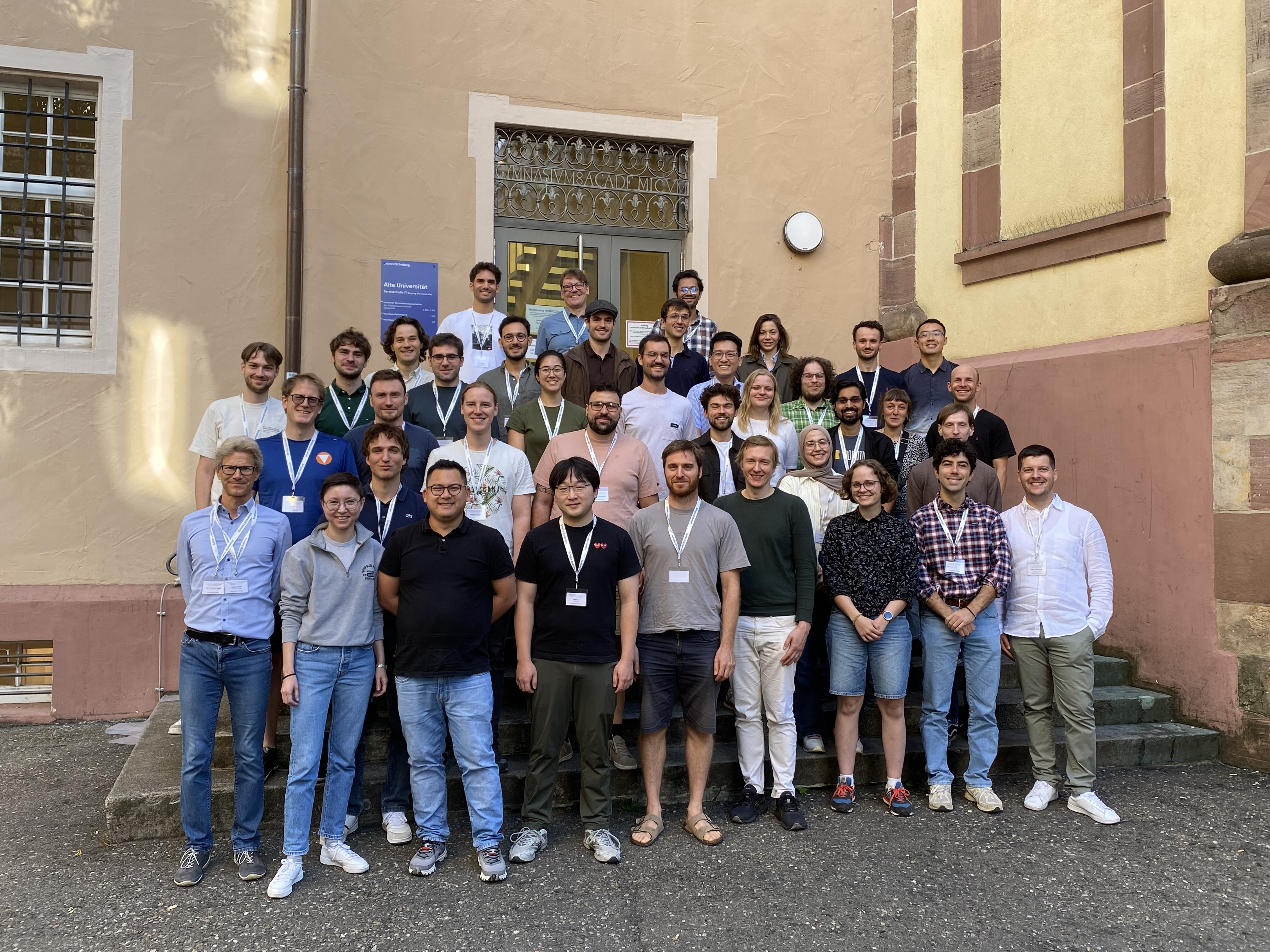
Please tell us what you liked about the school and how we can improve it in the future by filling out the feedback form.
Content
We are hosting a four-day PhD school on nonlinear mixed-integer and complementarity-constrained optimization. The main focus of the school is computational methods for solving mixed-integer nonlinear programs (MINLPs) and mathematical programs with complementarity constraints (MPCCs). The school covers the basics of the theory of nonlinear optimization, MINLPs, and MPCCs. We cover both classical algorithmic results, such as nonlinear branch-and-bound, outer approximation, regularization methods, active-set methods, and more, as well as the most recent developments for these problem classes. The school also presents modeling and formulation guidelines, discusses when it is preferable to use integer variables or complementarities for discrete and logical relations, and addresses practical aspects. In addition to the lectures, we will have interactive hands-on exercise sessions where participants apply these ideas to formulate and solve challenging optimization problems from various application fields. In addition, some insights about numerical optimization in industry will be provided by MOSEK's head of sales Gustaf Ehn.
Application fields. Nonlinear mixed-integer and complementarity optimization has a wide range of applications. For instance, integer decisions are ubiquitous in unit commitment problems. In an energy system with multiple producers, we must decide which generating units to use while respecting their operational conditions, such as startup times and minimum online and offline times. In topology design problems, we decide where to place material and how much to use.
Complementarity problems are also prevalent in engineering applications. Robotics problems involving frictional contact are one of the richest sources of such optimization problems. However, many other physical phenomena, such as phase changes and flow reversals, can also be conveniently expressed using complementarities.
Moreover, both complementarity and integer constraints can be used to express logical and conditional relations. For example, during spacecraft docking, specific constraints become active once the spacecraft is close to its target. Checkpoint and waypoint constraints in autonomous racing can be expressed similarly. Bilevel optimization, used for example in market design and portfolio optimization problems, can often be reformulated as an equivalent complementarity or mixed-integer problem.
During the exercises, we will consider several such applications and apply the methods introduced in the lectures to formulate and solve them. Participants will also have the opportunity to adapt a problem from their own research to this setting and present it to the audience.
Check out our flyer!
Exercises.
All exercise will be done in python via CasADi. The code for all exercises and installation instructions are available here! The repository contains the description of each problem and the related tasks.
Links to hackaton slides: https://github.com/wilke/claude-code-101.git.
Here you can register your project presentation for Friday!
Literature. We will provide the lecture slides for all lectures (links will be put in the schedule section below). In addition, we recommend several papers that cover classical and recent developments that will be discussed during the school.
Surveys/tutorials/PhD Theses on optimization with complementarity constraints
- MPEC methods for bilevel optimization problems. Y. Kim, S. Leyffer, and T. Munson
- Solving mathematical programs with complementarity constraints arising in nonsmooth optimal control. A. Nurkanović, A. Pozharskiy, M. Diehl
- Numerical methods for optimal control of nonsmooth dynamical systems. A. Nurkanović
Survey/tutorial on nonlinear mixed-integer optimization
- Mixed-integer nonlinear optimization. P. Belotti, C. Kirches, S. Leyffer, J. Linderoth, J. Luedtke, A. Mahajan
- A Comparative Study of MINLP and MPVC Formulations for Solving Complex Nonlinear Decision-Making Problems in Aerospace Applications. A. Ghezzi. A. Nurkanović, A. Weiss, M. Diehl, S. Di Cairano
Some recent algorithmic developments
- A Sequential Benders-based Mixed-Integer Quadratic Programming Algorithm and Its Implementation in the CAMINO Toolbox. A. Ghezzi, W. V. Roy, S. Sager, M. Diehl
- CCOpt: an Open-Source Solver for Large-Scale Mathematical Programs with Complementarity Constraints A. Pozharskiy, F. Pacaud, M. Diehl, A. Nurkanović
Registration Closed!
For registration, please complete this form.
Registration deadline: August 31, 2026. Deadline extended: 15.09.2026
Participation fee: 350 EUR.
The fee includes like coffee breaks during the event, and a dinner with the participants. Payments detail will be send by mail. Please note that the participation fee does not include accommodations or other travel expenses. There are plenty of hotels in Freiburg's old town, or outside the city with good public transportation connections. Participants are responsible for organizing their own stay.
Cancellation policy: no refund possible.
Please note that your registration will be considered complete only after we have received your payment. You will receive bank transfer details via email shortly after submitting your registration form. As registrations are processed manually, please allow some time before receiving your confirmation email.
Locations:
- Lectures: Max-Kade-Auditorium II (1st floor), Bertoldstraße 17, 79098 Freiburg im Breisgau
- Coffee breaks: Max-Kade-Auditorium I (ground floor, close to the enterance)/
Dinner: Dattler, Am Schlossberg 1, 79104 Freiburg im Breisgau, GoogleMaps,OpenStreetMap
The meeting point to hike to the dinner together. We meet at 18.30.
Freiburg mobility services:
Freiburg has a reliable tram services and many bike roads.
- You can buy tickets on the tram/bus or from the mobile app of VAG (local transportation company) GooglePlay, AppStore
- You can rent Frelo bikes at the Frelo stations dislocated around the city and you can ride your bike for 30 mins and bring it back to a Frelo station (this service for 6 Euro per month) Frelo website.
Schedule
Introduction slides.
Lecture slides:
Lecture 1: Modeling with mixed-integer nonlinear programs
Lecture 2: Modeling with mathematical programs with complementarity constraints
Lecture 3: LLM coding for optimization
Lecture 4: Nonlinear Programming Basics and Newton-Type Optimization (Part I, Part II, Part III)
Lecture 5: Theory of mathematical programs with complementarity constraints
Lecture 6: Algorithms for mathematical programs with complementarity constraints
Lecture 7: Outer approximation, Benders' decomposition
Lecture 8: Branch-and-bound for convex mixed-integer programs
Lecture 9: Nonconvex mixed-integer nonlinear programming
Lecture 10: Model predictive control for nonlinear and switched systems