
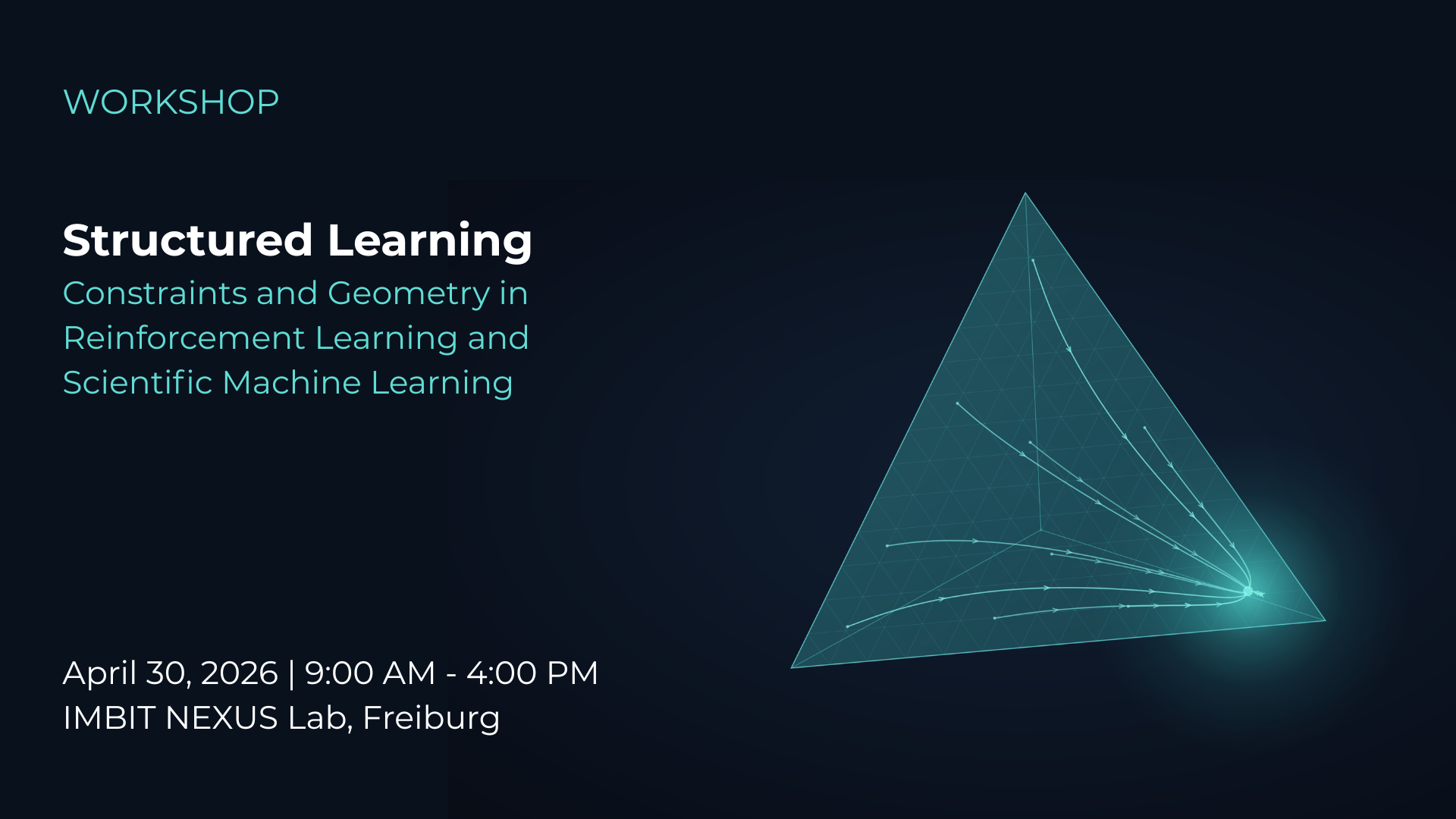
Workshop on Structured Learning: Constraints and Geometry in Reinforcement Learning and Scientific Machine Learning
Thursday, April 30, 2026, 9:00 - 16:00
IMBIT, Georges-Köhler-Allee 201, Nexus Lab
Abstract
How can machine learning respect the physical laws, safety constraints, and geometric structures of real-world problems? This one-day workshop brings together researchers at the intersection of reinforcement learning, optimal control, and scientific machine learning to explore structured approaches to learning. Four talks provide tutorials and current research insights, bridging the communities of reinforcement learning, optimal control, and scientific machine learning.
Organizers: Prof. Joschka Bödecker, Prof. Moritz Diehl, Leonard Fichtner, Jasper Hoffmann
Schedule & Slides
9:00 Grounding Diffusion Models with Optimal Control (Jasper Hoffmann, University of Freiburg) [Slides]
10:00 Coffee Break
10:30 Natural policy gradient methods: From geometric foundations towards safe RL (Dr. Johannes Müller, TU Berlin) [Slides]
11:30 Lunch
13:00 Optimal Control and Deep Learning? - Turnpikes, Dissipativity and Early Exits (Prof. Dr. Timm Faulwasser, TUHH Hamburg) [Slides]
14:00 Coffee Break
14:30 Resolving Ill-Conditioning in Scientific Machine Learning (Dr. Marius Zeienhofer, ETH Zürich) [Slides]
Talk Abstracts
Grounding Diffusion Models with Optimal Control (Jasper Hoffmann)
While diffusion models have achieved remarkable success in robot learning and autonomous driving, their application to complex planning remains an evolving frontier. This talk begins with a tutorial on diffusion through the lens of flow matching, framing it as a powerful, simulation-free alternative to traditional continuous normalizing flows (CNFs). We then explore how modern research ensures these models respect underlying system dynamics and hard safety constraints. Finally, we present a novel framework that integrates model predictive control (MPC) directly into the generative process, enabling more robust and feasible trajectory synthesis.
From Geometric Foundations Towards Safe RL (Dr. Johannes Müller)
Natural policy gradient and trust-region methods are central to modern reinforcement learning. In this talk, we present a unified perspective on policy optimization that connects information geometry, regularization, and constrained optimization. We first examine the geometric structure underlying natural policy gradient methods and show that they are induced by the conditional entropy regularization of a linear program. This allows us to study the error induced by entropy regularization in discounted Markov decision processes, yielding optimal convergence rates. Further, this shows that the natural policy gradient method prefer maximum entropy policies thereby characterizing the implicit bias of natural policy gradient methods. Building on this geometric framework, we construct trust-regions for constrained Markov-decision processes. This yields a safety-aware optimization scheme that enforce safety through geometric constraints.
Optimal Control and Deep Learning? - Turnpikes, Dissipativity and Early Exits (Prof. Dr. Timm Faulwasser)
Numerical optimization is a pivotal enabler for different machine learning methods. In particular, the training of deep neural networks relies on stochastic gradient descent algorithms and back propagation. At the same time, the data propagation through neural networks is akin to the computation of the trajectories of a dynamic system for different initial conditions. Hence it comes as no surprise that the training of neural networks can be formalized using the language and formalism of optimal control theory. In this talk, we focus on the optimal control perspective for training ResNets. We show that how system-theoretic dissipativity notions – which are due to Jan C. Willems – catalyzes dissipativitiy-informed design of training problems. We explore how the turnpike phenomenon – early observations of which can be traced back to John von Neumann – enables to derive depth bounds for ResNets. Moreover, explore the formal link of the proposed training formulation to early exiting and discuss the extension to architectures beyond ResNets. Numerical resutls for MNIST and CIFAR datasets underpin our analytic results.
Resolving Ill-Conditioning in Scientific Machine Learning (Dr. Marius Zeienhofer)
We present an 'optimize-then-project' approach for scientific machine learning that mitigates ill-conditioning arising from differential operators in loss functions. The key idea is to design algorithms at the infinite-dimensional level and subsequently discretize them in the tangent space of the neural network ansatz. We illustrate this approach in the context of physics-informed neural networks and the variational Monte Carlo method for quantum many-body problems, where neural networks have recently emerged as promising ansatz classes. We conclude with considerations related to the scalability of these schemes.